
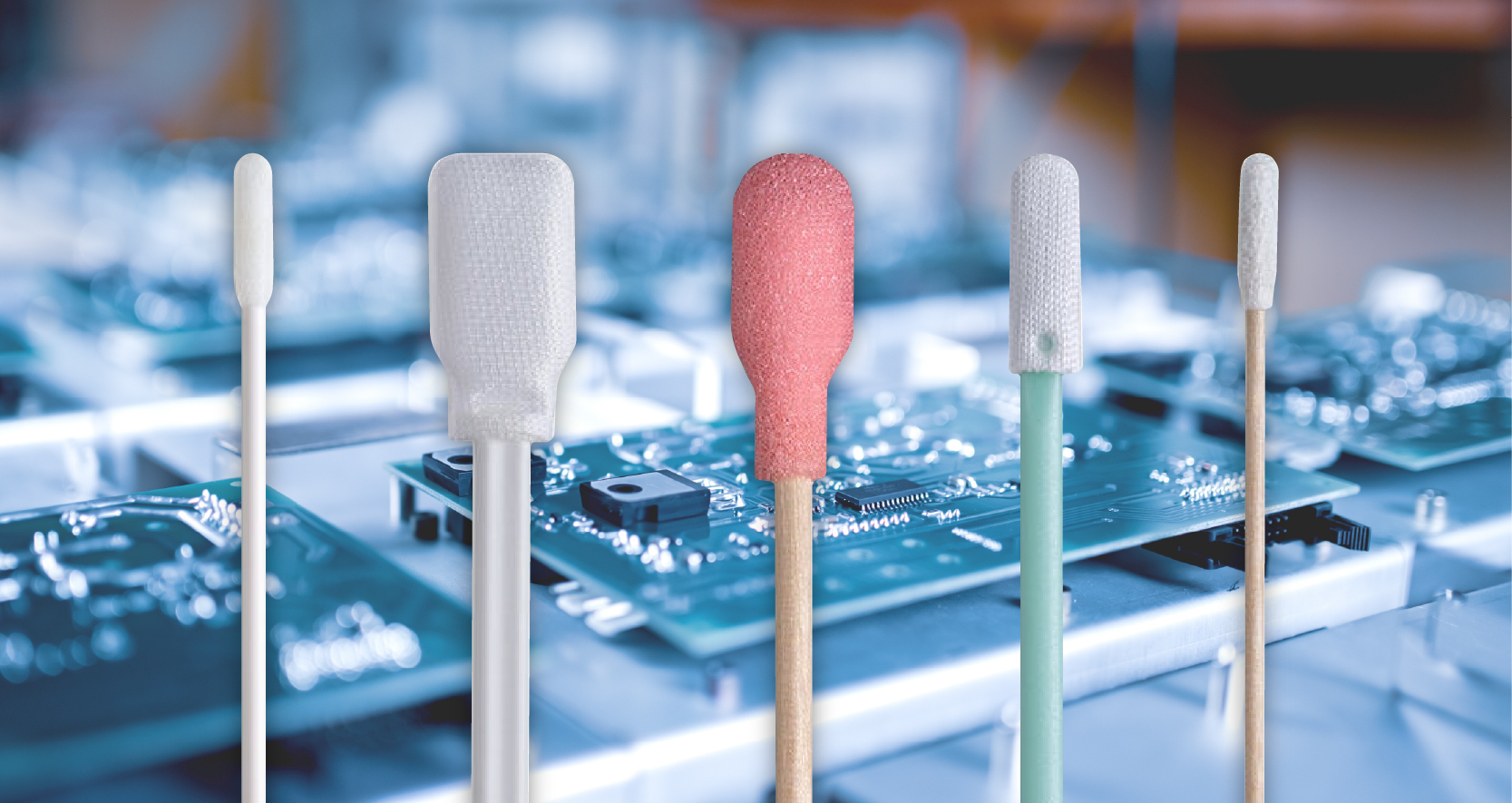
The wrong cleaning swab in the wrong application creates the exact problem it was supposed to solve.
Fibers on a PCB. Residue on an optical lens. Particulate in a pharmaceutical batch. A softened tip that leaves adhesive on a fiber-optic connector. These aren't hypotheticals. They're the reason cleanroom managers, precision-manufacturing teams, and detailing professionals develop opinions, select specific SKUs and create protocols that require strict adherence.
This guide is for buyers, technicians, and specifiers who need to choose a cleaning swab and want to make the choice once, correctly.
It covers what a cleaning swab actually is, the four questions to work through before selecting one, the material and geometry options that map to different applications, and the specific product lines that serve each use case.
It's written for the range of industries that depend on this decision: electronics assembly, printer maintenance, pharmaceutical manufacturing, cleanroom operations, medical device work, precision automotive detailing, and industrial equipment maintenance.
What Is a Cleaning Swab?
A cleaning swab is a single-use applicator designed to remove contamination from surfaces even if they are small, precise, or hard-to-reach surfaces. The tip is the working end, the part that contacts the surface, and the handle is the delivery mechanism. Together, they make the swab a tool for controlled, localized cleaning where a wipe would be too large, a brush too abrasive, or a rinse impossible.
Cleaning swabs are not specimen collection swabs. The two look similar and share some materials, but they're engineered for different purposes. Specimen collection swabs are optimized to pick up biological material and release it into a downstream test. Cleaning swabs are optimized to pick up and remove contamination, dust, residue, adhesive, flux, biofilm, and either remove it from the surface or transfer it into a solvent that carries it away. Using a specimen swab as a cleaning tool, or vice versa, tends to produce disappointing results in both directions.
Everything about a cleaning swab's design serves the cleaning function. Tip materials are chosen for absorbency, lint characteristics, and chemical compatibility. Handle materials are chosen for strength, chemistry compatibility, and ergonomics. Tip geometry is chosen for the surface being cleaned. Getting these right for your application is the difference between a tool that works and one that adds problems to the process it was meant to prevent.
Four Questions to Ask Before Choosing a Cleaning Swab
Cleaning swab selection is a decision with four inputs. Answer them in order and the right product usually surfaces on its own.
1. What Are You Cleaning?
The surface itself is the starting point. A printed circuit board is a different problem than an optical lens, which is a different problem than a stainless steel pharmaceutical mixing tank, which is a different problem than a car interior trim panel.
Consider three things about the surface: how sensitive it is to physical damage, how sensitive it is to fiber or particulate contamination, and its geometry. A PCB is delicate and highly sensitive to lint. An optical lens is delicate and sensitive to any contamination. Stainless steel is durable but sensitive to particulate at the pharmaceutical level. A car console is durable but tight-cornered.
Match the swab to the surface's most demanding requirement, not its average one.
2. What Is the Contaminant?
Different contaminants respond to different swab strategies.
Loose dust and particulate transfer to a dry swab or one lightly wetted with IPA. Adhesive residue and flux respond to a foam swab with an appropriate solvent, where the foam dissolves the material and lifts it clear. Biofilm and organic buildup often require both scrubbing action and a chemistry that breaks the bond, which pushes toward foam or foam-over-cotton constructions. Ink and toner residues in printer heads want fine tips that reach into narrow channels without spreading material outward.
Identifying the contaminant helps you decide between absorbency (cotton, foam-over-cotton), lift and release (foam), and abrasion-safe pickup (polyester, microfiber).
3. What Environment Are You Working In?
Environment shapes the acceptable lint and particulate generation profile of the swab itself.
Cleanrooms classified under ISO 14644, the international standard for airborne particle concentration, have specific limits on the particles that can exist in the air, and by extension, on what you can introduce during cleaning. ISO Class 5 and cleaner environments typically call for cleanroom-manufactured polyester or foam swabs with documented particulate generation. General industrial floors, tool cribs, and detailing bays don't impose that same discipline, which opens up cost-effective options that would be unacceptable in a semiconductor fab.
The higher the environment's cleanliness class, the more the swab itself must contribute to, not detract from, that class.
4. What Solvent Will You Use?
Most cleaning tasks involve a solvent. The solvent has to be compatible with what you're cleaning, but it also has to be compatible with the swab itself.
Isopropyl alcohol and DI water are broadly compatible with standard cleaning swabs. Acetone, MEK, toluene, and certain flux removers can dissolve or swell standard polyurethane foam and can craze or soften polystyrene handles.
For these more aggressive chemistries, chemical-resistant foam and polypropylene handles are the safer choice. For information on chemistry-specific selection, see our chemical-resistant swabs guide.
With those four questions answered, the material selection follows naturally. Here's how the primary material options map to real applications.
How to Match Your Cleaning Swab Material to the Application
Foam Cleaning Swabs
Foam is the workhorse of the precision cleaning world. Puritan's foam-tipped applicators are built on 100 pores-per-inch (PPI) polyurethane foam, a continuous cellular structure with no woven or spun fibers to shed. The tip is thermally bonded to the handle rather than adhesive-bonded, which eliminates a common source of contamination on critical surfaces.
Best for: Electronics assembly, printed circuit board rework, fiber optics, cleanroom surface cleaning, medical device manufacturing, precision detailing, printer head maintenance, solvent-based applications with IPA or DI water.
Not ideal for: Aggressive solvents like acetone, MEK, or strong flux removers (these call for chemical-resistant foam). High-absorbency applications requiring more fluid capacity than a standalone foam tip provides.
Puritan Product highlights:
-
1806-PF — 6" foam tip on polypropylene handle. General-purpose precision cleaning workhorse.
-
1806-WF — 6" foam tip on wood handle. Cost-effective alternative where polypropylene isn't required.
-
1806-PCF — Foam-over-cotton on polypropylene handle. Combines the lint-free outer surface with a cotton core for higher fluid capacity.


For the full range of foam swab configurations and industrial applications, see our foam swabs industrial uses guide.
Polyester and Microfiber Cleaning Swabs
Polyester and microfiber tips are non-abrasive, low-particulate, and solvent-tolerant. They're manufactured in Puritan's cleanroom environment and thermally bonded to polypropylene or acetal handles. Where foam excels at absorbency and lift, polyester excels at particulate control and durability across a wide range of solvents.
Best for: Cleanroom operations at ISO Class 5 and cleaner, fiber optics maintenance, precision electronics, pharmaceutical equipment cleaning, applications involving aggressive solvents where standard foam would degrade, tasks requiring specific tip geometries (small paddle, half-round, ultrafine).
Not ideal for: High-absorbency applications where foam-over-cotton would perform better. Consumer-grade applications where the cost differential isn't justified.
Puritan Product highlights:
-
3620 — Small round polyester tip on polypropylene handle. Precision cleaning workhorse for tight tolerances.
-
3655 — Large flat paddle polyester tip. Broader surface coverage without loss of lint control.
-
3130 — Small flexible paddle microfiber tip on polypropylene. Ultra-fine geometry for precision electronic and optical work


For a closer look at how foam and polyester swabs compare in pharmaceutical and cleanroom applications, see our post on foam and polyester swabs for pharmaceutical manufacturing environments.
Cotton and Low-Lint Cotton Swabs
Cotton is the most familiar cleaning swab material, and it earns that familiarity in general industrial and less-sensitive applications where absorbency and cost matter more than absolute lint control. Puritan's cotton swabs use pharmaceutical-grade cotton on wood, polystyrene, or paper handles, with several configurations engineered specifically to minimize linting.
Best for: General industrial cleaning, tool crib applications, cosmetic detailing, wound care, low-sensitivity electronics work, applications where absorbency is the priority and some lint is acceptable, buccal-adjacent applications outside diagnostic use.
Not ideal for: Class-rated cleanroom environments (foam or polyester is the standard choice there), critical PCB rework, optical work, applications where any fiber contamination is a problem.
Puritan Product highlights:
-
806-WC — 6" cotton on wood handle. Puritan's most versatile and widely used general-purpose swab.
-
803-WC — 3" cotton on wood handle. Shorter form for tighter workspaces.
-
806-WCL — Extra-large cotton tip on 6" wood handle. Higher absorbency for larger cleaning tasks.
-
870-PC DBL — Compressed cotton on fine paper handle, double-ended. Very low lint for a cotton construction.

For a deeper treatment of lint-free vs. low-lint terminology and how to think about the tradeoff, see our lint-free swabs guide.
Chemical-Resistant Cleaning Swabs
Chemical-resistant swabs are a specialty subcategory built for applications where standard foam would degrade in contact with the solvent. Puritan's chemical-resistant line uses closed-cell polyethylene foam that resists acetone, MEK, and other aggressive chemistries, paired with wood or polypropylene handles selected for their own chemical compatibility.
Best for: Semiconductor manufacturing, aerospace precision cleaning, applications using acetone, MEK, toluene, or aggressive flux removers, facilities transitioning solvents in response to the EPA's TCE phase-out.
Not ideal for: General cleaning with IPA or water (standard foam is more cost-effective and performs equivalently). High-fluid-volume absorbency applications.
Puritan Product highlights:
-
1806-PCF CR — Chemical-resistant foam-over-cotton on polypropylene handle.
-
1806-WF CR — Chemical-resistant foam tip on wood handle. General-purpose chemical-resistant option.
-
1876-PF CR — Flexible chemical-resistant paddle foam tip on polypropylene.

For the full treatment including solvent compatibility guidance, see our chemical-resistant swabs guide.
A Note on Selection Frameworks
The table below summarizes the material-to-application map for readers who want the fast version:
|
Application |
Foam |
Polyester |
Cotton |
Chem-Resistant |
|
Cleanroom |
|
preferred |
— |
(harsh solvents) |
|
PCB rework and electronics |
preferred |
— |
(flux removed) |
|
|
Fiber Optics |
preferred |
— |
— |
|
|
Pharmaceuitical equipment |
preferred |
— |
(harsh solvents) |
|
|
Medical device cleaning |
preferred |
— |
||
|
Printer heads |
preferred |
— |
— |
|
|
Precision detailing |
preferred |
— |
— |
|
|
General industrial cleaning |
— |
preferred |
(harsh solvents |
|
|
Tool crib and shop maintenance |
— |
preferred |
— |
Common Clean Swab Application Playbooks
Selection frameworks help, but real cleaning tasks come with their own established patterns. Here are the applications that drive the most consistent buyer questions, and how to think through each.
Electronics Assembly and PCB Rework
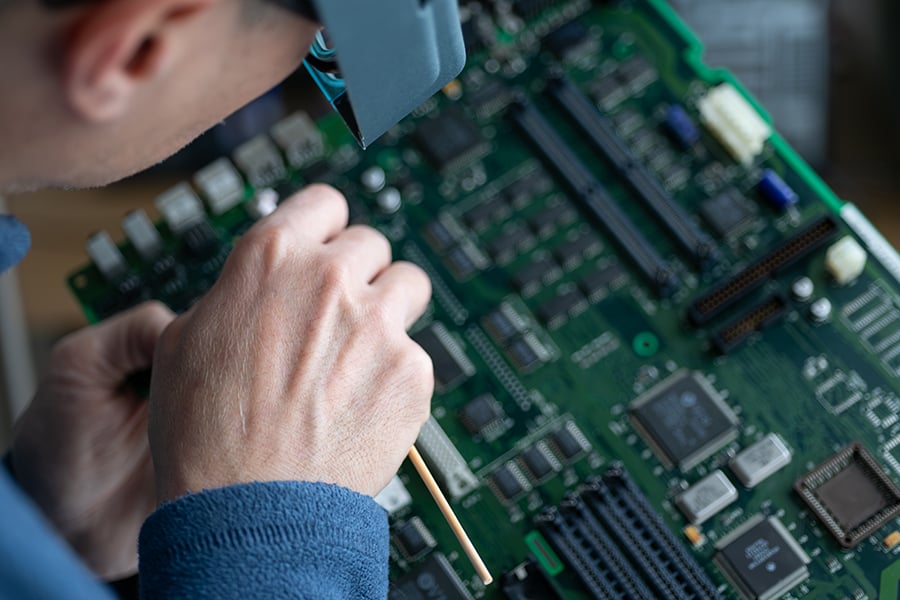
Electronics work is where cleaning swab selection matters most and where getting it wrong costs the most. Loose fibers on a solder joint or a fine-pitch IC create real quality problems, and the surfaces themselves are delicate enough that abrasion has to be controlled.
Foam swabs are the standard choice: no shedding, IPA-compatible, and the tip conforms to a soldered joint or connector without leaving residue. For flux removal specifically, the choice between standard foam and chemical-resistant foam depends on the flux chemistry. Rosin fluxes clean well with standard foam and IPA. More aggressive water-white and no-clean flux residues sometimes call for chemical-resistant foam with a matched solvent.
Small-tip foam configurations (1803 series) work well for individual joints and connector pins. Standard-tip foam (1806 series) handles larger areas and general PCB cleaning.


Cleanroom Surface and Component Cleaning
Cleanroom cleaning is disciplined by the room's ISO classification and by the facility's approved cleaning materials list. In practice, polyester swabs manufactured in cleanroom conditions dominate ISO Class 5 and cleaner work because their particulate generation is documented and predictable.
Foam is also widely used and appropriate in cleanroom applications, particularly for equipment cleaning and process residue removal. The choice between the two often comes down to which material is on the facility's approved materials list and what solvent chemistry the process specifies.
For pharmaceutical facilities specifically, cleaning validation is a regulatory concern. The FDA's Guide to Inspections Validation of Cleaning Processes specifies that firms must "show that contaminants can be recovered from the equipment surface and at what level" — a requirement that ties directly to swab selection.
According to the FDA guide, "the adhesive used in swabs has been found to interfere with the analysis of samples," which is one reason thermally bonded swabs are preferred in cleaning validation programs.
For a deeper treatment, see our post on swab cleaning validation.
Printer Head and Precision Ink Path Maintenance
Printer maintenance is one of the highest-volume cleaning swab applications by unit count. The task involves delicate print heads, tight ink channels, and residues that dry into films if not addressed promptly.
Fine-tip foam swabs are the workhorse choice: small enough to reach into ink channels, absorbent enough to lift dried residue, lint-free enough to avoid depositing fibers where dislodged ink can pick them up.
Standard 6" foam swabs on polypropylene handles suit the majority of printer applications. For particularly fine work, small-tip configurations like the 1803 series or ultrafine polyester tips work well.
Medical Device Manufacturing and Cleaning
Medical device manufacturing has its own vocabulary around cleanliness — biocompatibility, endotoxin levels, particulate limits — but the swab-selection logic is familiar. Cleanroom-manufactured foam and polyester swabs handle most component and finished-device cleaning.
For specific applications like infusion pump maintenance, foam-tipped configurations serve well; see our post on foam-tipped swabs for cleaning infusion pumps.
The critical difference in medical device work is documentation. Certificates of conformance, material traceability, and manufacturing consistency matter more than absolute performance differences.
This is where a U.S.-based manufacturer with an ISO 13485-certified facility is more than a marketing point.
Request a Certificate from Puritan Here
Precision Automotive Detailing
Auto detailing sits at the accessible end of precision cleaning. The surfaces vary widely — leather, plastic trim, painted metal, fabric, glass — and the tolerances aren't as tight as electronics, but the visual quality standard is real. Small-tip foam and cotton swabs handle vents, seams, gauge clusters, and other tight-space cleaning that a microfiber cloth can't reach.
For a treatment specifically aimed at detailing professionals, see our car detailing swabs guide.
Specialty Applications
Beyond the mainstream categories, cleaning swabs turn up in applications that aren't obvious. Woodwind instrument key mechanism cleaning, gun bore cleaning, jewelry maintenance, and precision hobbyist applications all rely on swabs designed for cleaning rather than sampling.
For an example of one of these specialty use cases, see our post on using foam-tipped swabs to care for woodwind instruments.
Cleaning Swab Handle and Tip Geometry
Material choice covers most selection decisions, but geometry — handle length, tip shape, and stem flexibility — determines whether the swab actually reaches and works on the surface you're cleaning.
Handle length
Standard swabs are 3 inches (short-reach) or 6 inches (general-purpose). Extra-long configurations reach 8, 12, and 16 inches for deep-cavity work, industrial channel cleaning, and applications where the operator needs distance from the work.
See our extra-long swabs buyer's guide for the range.
Tip geometry
Standard round tips serve general applications. Small and micro tips reach into vents, ports, seams, and tight-tolerance components. Paddle and rectangular tips cover more surface area with fewer passes. Pointed tips access corners and edges that a round tip can't reach.
For a treatment specifically aimed at tight-space applications, see our tiny swabs guide.
Handle material
Wood is cost-effective and chemically broad but not ideal for critical environments. Polypropylene handles well with a wide range of solvents and is standard for controlled-environment work.
Polystyrene is common on medical-style swabs but can craze in aggressive solvents.
Paper handles support very low particulate generation but sacrifice rigidity.
Matching geometry to the physical task is often what separates an okay cleaning result from a good one, especially when the operator is trying to clean something they can't fully see.
Why Choose Puritan for Your Cleaning Swabs
Puritan Medical Products has produced medical devices at our facility in Guilford, Maine since 1919.
The cleaning swab lineup is engineered specifically for the industries that make selection decisions carefully — pharmaceutical and biotech manufacturing, electronics assembly, cleanroom operations, medical device production, precision detailing, and industrial applications where a wrong swab creates real problems.
A few things worth knowing:
-
Manufacturing consistency: Foam tips are produced on 100 PPI polyurethane foam with thermal bonding to the handle. Polyester and microfiber tips are manufactured in cleanroom conditions to control particulate generation. Certificates of conformance and material documentation are available for regulated buyers.
-
Application depth: Puritan's cleaning swab catalog spans small-tip through paddle-tip foam, standard through ultrafine polyester and microfiber, low-lint cotton across multiple constructions, chemical-resistant foam for aggressive solvents, and specialty geometries for tight-space and long-reach work. The range means most cleaning applications map to a standard SKU rather than requiring a custom order.
-
Custom capability: For OEM buyers, kit developers, and specialized industrial applications, Puritan supports custom handle configurations, custom breakpoint positions, private-label packaging, and finished kit assembly at meaningful volume.
-
U.S. manufacturing: All Puritan brand swabs are manufactured in Maine. For buyers where domestic sourcing, shorter lead times, and easier quality communication matter, this is a meaningful practical advantage. For a deeper look at Puritan's cleanroom-relevant capabilities, see Why Puritan Swabs are Ideal for Critical Environments and Cleanrooms.
Whether you're restocking a supply cabinet or evaluating for a full facility program, we're set up to help. Shop Puritan on Amazon for standard SKUs or contact our sales team to discuss custom configurations, bulk orders, and OEM programs.
Frequently Asked Questions
What is a cleaning swab used for?
A cleaning swab is a single-use applicator used to remove contamination — dust, residue, adhesive, flux, biofilm, or other soils — from small, precise, or hard-to-reach surfaces. Cleaning swabs are used in electronics assembly, printer maintenance, cleanroom operations, pharmaceutical and medical device manufacturing, precision detailing, fiber optics work, and industrial equipment maintenance.
What's the difference between a cleaning swab and a Q-tip?
Consumer Q-tips are cotton swabs designed for general home use, typically manufactured to less exacting specifications than industrial and precision cleaning swabs. Cleaning swabs used in electronics, cleanroom, and manufacturing environments are engineered for specific performance characteristics: controlled particulate generation, thermally bonded tips to prevent adhesive contamination, specific handle materials for solvent compatibility, and consistent tip geometry. The material, construction, and quality controls are meaningfully different.
Are foam swabs better than cotton swabs for cleaning?
Foam and cotton serve different purposes. Foam is lint-free, non-abrasive, and better for critical environments, sensitive electronics, and precision cleaning. Cotton is more absorbent and cost-effective, but sheds fibers and isn't appropriate for class-rated cleanroom or fine-electronics work. Foam is the better choice when lint or particulate contamination would compromise the work; cotton is the better choice for general industrial cleaning where absorbency matters and some lint is acceptable.
What are foam-tipped swabs made of?
Foam-tipped swabs are typically constructed with 100 pores-per-inch polyurethane foam, thermally bonded to a polypropylene, wood, or polystyrene handle. The continuous cellular structure means no woven or spun fibers to shed. For aggressive solvent applications, chemical-resistant foam swabs use closed-cell polyethylene foam instead of polyurethane.
Can I use cleaning swabs on electronics?
Yes. Foam-tipped cleaning swabs are widely used in electronics assembly, PCB rework, and printer maintenance because they're lint-free and compatible with common cleaning solvents like isopropyl alcohol. Small-tip and micro-tip configurations reach into tight spaces on circuit boards, connectors, and print heads. Avoid cotton swabs for critical electronics work — the fibers can compromise solder joints and delicate components.
What are lint-free cleaning swabs?
Lint-free cleaning swabs are engineered to minimize or eliminate fiber shedding during use. True lint-free swabs use polyurethane foam, which has a continuous cellular structure and no fibers to shed. Polyester and microfiber swabs are virtually lint-free — they generate very low particulate but aren't quite zero. Cotton swabs marketed as "lint-free" are more accurately described as low-lint or lint-controlled. For a full treatment of the distinction, see our lint-free swabs guide.
How do I choose a cleaning swab for a cleanroom?
For ISO 14644-classified cleanrooms, cleanroom-manufactured polyester swabs are the standard choice for ISO Class 5 and cleaner. Foam swabs are also widely used and appropriate in cleanroom applications. Match the swab's documented particulate generation to the environment's classification, confirm chemical compatibility with your approved cleaning agents, and check that thermal bonding (rather than adhesive) is used to prevent adhesive transfer.
What's the difference between industrial and consumer cleaning swabs?
Industrial cleaning swabs are engineered for specific performance requirements: controlled particulate generation, chemical compatibility, thermal bonding, specific tip geometries, and consistent manufacturing to defined specifications. Consumer swabs are typically cotton on paper or plastic handles, designed for general home use without the manufacturing controls or material specifications that industrial applications require. Using a consumer swab for industrial cleaning often produces lint, residue, and inconsistent results.
What's the best solvent to use with a cleaning swab?
Isopropyl alcohol (typically 99% or 91%) is the most common solvent for precision cleaning and is broadly compatible with standard cleaning swabs. DI water is used for water-soluble contaminants and is compatible with all standard swabs. Acetone, MEK, toluene, and aggressive flux removers require chemical-resistant swabs — standard polyurethane foam and polystyrene handles can degrade in contact with these chemistries. Always confirm swab-solvent compatibility for your specific application.
How do I know if a swab is compatible with my process?
The answer depends on your application. For pharmaceutical cleaning validation, follow your validated procedure and consult the FDA's Guide to Inspections Validation of Cleaning Processes.
For cleanroom applications, consult your facility's approved materials list and the swab manufacturer's documented particulate generation data.
For any application, request a certificate of conformance from the manufacturer and, where possible, request a sample quantity to validate for your intended application.