

The wood-handled cotton swab is one of the oldest and most versatile swab configurations Puritan makes. It's also one of the most misunderstood by buyers who need it for a specific application. Cotton on wood sounds like a single thing, but it's actually a whole family of products — different tip sizes, different tip shapes, different handle lengths — each engineered for a specific use.
This guide is for buyers, procurement teams, and specifiers who need to choose the right wood stick cotton swab for their application. It covers what a wood stick cotton swab is, when to use it, the standard sizes and tip formats available, and how to select the right Puritan SKU for medical, clinical, industrial, and cosmetic use.

What is a Wood Stick Cotton Swab?
A wood stick cotton swab is a single-use applicator made of absorbent cotton wound around a wooden handle. The cotton tip contacts the surface or specimen; the wooden handle provides rigidity and controlled application. Wood is a traditional and cost-effective handle material that pairs well with cotton — both are naturally derived, chemically neutral, and compatible with the broad majority of medical, forensic, industrial, and cosmetic applications.
Wood stick cotton swabs are used across an unusually wide range of settings:
- General medical use in hospitals and physician offices
- Wound care and topical medication application
- Non-critical specimen collection
- Forensic evidence collection
- Industrial cleaning and tool crib applications
- Cosmetic and dermatology applications
- Educational and training use
- Laboratory research
For a broader overview of cotton swab applications across all handle types, see our complete guide to cotton swabs.

When to Choose a Wood Stick Cotton Swab
Handle material affects cost, rigidity, chemical compatibility, and how a swab is disposed of after use. Wood handles have a specific set of strengths that make them the right choice in some applications and the wrong choice in others.
A wood stick cotton swab is ideal for:
- Cost matters and volume is high
- The application is not in a class-rated cleanroom environment
- The solvent or medium is water-based, mild alcohol-based, or a common clinical antiseptic
- The application benefits from wood's natural rigidity. The wood shaft can break readily leaving a pointed, sharp end, which has value in some applications
- Disposal is straightforward (wood is biodegradable, which matters for some healthcare and cosmetic settings)
- While both wood and cotton can stand up to aggressive solvents, the adhesive used to attach the cotton bud to shaft may not. For use in industrial applications, where harsh solvents are used, consider cotton with a hot melt adhesive
Consider a different handle material if:
- The application is in a class-rated cleanroom where wood particulate is a concern
- You need chemical compatibility with aggressive solvents (polypropylene is generally safer)
- The application is molecular diagnostics where wood's natural residues could interfere with PCR
- You need a specific breakpoint position for kit assembly (plastic handles typically have engineered breakpoints)
For applications where a plastic handle is a better fit, Puritan offers polystyrene and polypropylene cotton swabs across most tip formats.
Wood Stick Cotton Swab Sizes and Tip Formats
Puritan's wood stick cotton swabs come in two handle lengths and four tip formats, giving buyers eight combinations that cover the majority of use cases.
6" Wood Handle Cotton Swabs
The 6-inch length is the general-purpose standard. It provides enough reach for most clinical, industrial, and cosmetic applications while remaining manageable for one-handed use.
Standard tip — 806-WC

The workhorse of the wood stick cotton swab family. Standard-size cotton tip on a 6-inch wooden handle. Used across general medical or healthcare settings, wound care, industrial cleaning, and cosmetic applications where a standard-size tip covers the task.
Small tip — 868-WCS
Standard 6-inch wooden handle with a smaller cotton tip. Useful when the application involves tighter anatomy or component geometry, or when a controlled smaller dose of fluid or medication is preferred.
Large tip — 806-WCL

Standard 6-inch wooden handle with an oversized cotton tip. The larger tip holds more fluid and covers more surface area per pass. Well-suited to canine ear cleaning in veterinary practice, larger wound care applications, and industrial cleaning tasks where absorbency matters more than fine tip control. For more on this format specifically, see our guide to extra-large cotton swabs.
Tapered small tip — 826-WC

Standard 6-inch wooden handle with a tapered cotton tip that comes to a finer point. Well-suited to precision applications where the operator needs to reach into smaller spaces than a standard tip allows, but with more control than a fully round mini-tip.
3" Wood Handle Cotton Swabs
The 3-inch length is used for applications where the shorter handle helps with control, or where the workspace doesn't accommodate a longer stick.
Standard tip — 803-WC

The 3-inch counterpart to the 806-WC. Standard cotton tip on a shorter wood handle. Common in cosmetic applications, tight-space industrial cleaning, educational use, and healthcare applications where shorter reach is preferred.
Small tip — 838-WCS

3-inch wood handle with a smaller cotton tip. Useful for precision cosmetic work, delicate cleaning tasks, and applications where a small tip on a shorter handle offers the best control.
Large tip — 803-WCL
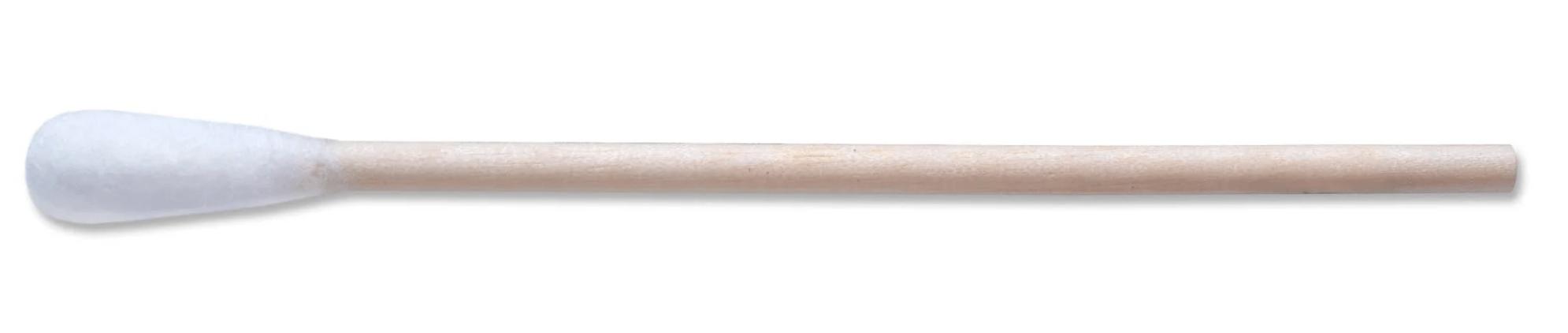
3-inch wood handle with an oversized cotton tip. Higher absorbency in a shorter form factor.
Tapered small tip — 823-WC

3-inch wood handle with a tapered cotton tip. Combines the fine access of a tapered tip with the control of a shorter handle.
Size and Tip Reference Table
For a quick reference of the ideal swab for your application, check out this summary table:
|
Length |
Standard |
Small |
Large |
Tapered Small |
|
6" |
||||
|
3" |
Sterile vs. Non-Sterile Wood Stick Cotton Swabs
Most Puritan wood stick cotton swab SKUs are available in both non-sterile bulk configurations and sterile individually-packaged versions. Sterile versions typically add "25-" prefix or "2WC" suffix to indicate the sterile pack format.
Non-sterile swabs are best when:
- The application is industrial cleaning, cosmetic use, or general non-clinical
- Cost per unit matters and the environment doesn't require sterility
- The swabs will be used in a non-patient-contact context
Sterile wood swabs are best when:
- The application involves open skin, wounds, or mucous membranes
- The swab is used for specimen collection or clinical testing
- Sterile field procedures are involved, including forensic evidence collection
- The application involves immunocompromised patients
- Used in a tool kit to protect against fraying or contact with other materials - wrapper keeps tip protected
Sterile Puritan wood stick cotton swabs are sterilized via ethylene oxide, meet Sterility Assurance Level (SAL) of 10⁻⁶ per ISO 11135, and are wrapped (individually or in multiples with a lot) with lot codes and expiration dates for traceability.
Wood Stick Cotton Swab Applications by Industry
Medical and Clinical Wood Stick Cotton Swabs
The 806-WC and its sterile counterpart are the everyday workhorses of the wood stick cotton swab family in healthcare settings. Common applications include:
- General clinical use (wound cleaning, topical medication application, minor procedures)
- Dermatology and cosmetic dermatology
- Educational use in nursing, medical, and dental training
- Forensic applications and evidence collection
For applications requiring larger absorbency, the 806-WCL is the standard choice. For tight-space applications, the 868-WCS or the tapered 826-WC provide better control.
Industrial Wood Stick Cotton Swabs
Wood stick cotton swabs are widely used in industrial cleaning, tool cribs, and precision maintenance where the environment doesn't require lint control at cleanroom-classification levels. The 806-WC handles general industrial cleaning; the 806-WCL is used for higher-absorbency applications; the tapered 826-WC and small-tip 868-WCS reach into tight spaces on equipment. You might also consider 850-WC POLY/850-WCB POLY for its sturdy handle and wide application use.
For industrial applications requiring higher lint control, see our lint-free swabs guide.
Veterinary Wood Stick Cotton Swabs
Canine ear cleaning is the classic veterinary application for the 806-WCL. The large cotton tip absorbs earwax and cleaning fluid effectively, and the 6-inch length provides enough reach without being unwieldy. For small mammal and exotic veterinary work, the 838-WCS and 823-WC provide the finer tip formats those applications require.
Cosmetic and Personal Care Wood Stick Cotton Swabs
The 3-inch wood stick cotton swab family (803-WC, 838-WCS, 803-WCL, 823-WC) covers most cosmetic applications. Standard tips handle general makeup application and correction; small and tapered tips reach into corners and fine detail work; large tips handle broader coverage tasks.
How to Choose the Right Wood Stick Cotton Swab for Your Application
Selection comes down to four questions:
1. What handle length works for the task? 6-inch for general healthcare, industrial, and veterinary applications. 3-inch for cosmetic, tight-space, and educational applications.
2. What tip size matches the surface or specimen? Standard for most general applications. Small for tight anatomy or precision work. Large for higher absorbency or broader coverage. Tapered small for precision access with slightly more control than a fully rounded mini-tip.
3. Do you need sterile packaging? Sterile for any patient-contact, specimen collection, wound care, when they’re stored or carried with other tools and materials, or for sterile-field application. Non-sterile for industrial, cosmetic, and general non-clinical use.
4. What's your order volume? Wood stick cotton swabs are sold in both bulk (typically 10,000 per case for non-sterile) and clinical packaging (typically 2,000 per case for sterile). For wholesale purchasing considerations, see our wholesale swabs guide.
Puritan’s Wood Stick Cotton Swabs
Puritan has manufactured wood stick cotton swabs at our facility in Guilford, Maine since 1919 . The wood stick cotton swab family is one of Puritan's oldest and most widely used product lines, and the manufacturing consistency reflects that century of specialization.
Manufacturing consistency. Cotton fiber is USP-grade, absorbent, and carded on site, and to consistent tip specifications across production runs. Wooden handles are quality-controlled for splinters, uniformity, and appropriate stiffness.
Regulatory infrastructure. Puritan is FDA-registered, ISO 13485 certified, and CE marked. Certificates of Analysis and Certificates of Conformance are available for regulated buyers.
American manufacturing. All Puritan swabs are manufactured to Puritan’s demanding specifications. For medical buyers, procurement teams, and industrial buyers who value shorter lead times and easier quality communication, this is a real practical advantage.
Bulk and custom capability. For high-volume buyers, kit developers, and specialty applications, Puritan supports bulk purchasing across the full wood stick cotton swab line and custom configurations at meaningful order volume.
Frequently Asked Questions
What is a wood stick cotton swab?
A wood stick cotton swab is a single-use applicator made of absorbent cotton wound around a wooden handle. Wood stick cotton swabs are used in medical, clinical, industrial, veterinary, and cosmetic applications, and are available in a range of tip sizes and shapes to suit different tasks.
What are the different sizes of wood stick cotton swabs?
Puritan's wood stick cotton swabs come in two handle lengths: 6-inch (for general-purpose clinical, industrial, and veterinary use) and 3-inch (for cosmetic, tight-space, and educational applications). Each length is available in four tip formats: standard, small, large, and tapered small.
What is the difference between a small tip and a tapered tip cotton swab?
A small tip is a fully rounded miniature cotton tip. A tapered tip is made with a tapered wood shaft that comes to a finer point, providing more precise access to tight spaces while still offering more control than a fully mini-tipped swab. Tapered tips are useful when the operator needs to reach into small areas but wants more surface contact than a round mini-tip provides.
Are wood stick cotton swabs safe for wound care?
Sterile wood stick cotton swabs are widely used in wound care, particularly for cleaning and applying topical medications. Non-sterile wood stick cotton swabs are not appropriate for wound care because they may introduce introduce microbial contamination. Always use sterile versions for any application involving open skin, wounds, or mucous membranes.
What are wood stick cotton swabs used for in a hospital?
In hospitals, wood stick cotton swabs are used for wound cleaning, topical medication application, minor clinical procedures, non-critical specimen collection, dermatology tasks, and general clinical care. The 806-WC (6-inch standard tip) is the everyday workhorse in most clinical settings.
Can wood stick cotton swabs be used in a cleanroom?
Wood stick cotton swabs are not typically appropriate for class-rated cleanroom environments because wood generates particulate and cotton generates lint. For cleanroom applications, foam or polyester swabs with plastic handles are the standard choice. For more on cleanroom swab selection, see our cleaning swabs guide.
Where can I buy wood stick cotton swabs in bulk?
Puritan wood stick cotton swabs are available directly from Puritan for wholesale purchasing, through authorized distributors including Fisher Scientific, VWR, McKesson, and specialty medical distributors, and on the Puritan Amazon storefront for smaller-volume buyers.
What's the difference between a wood handle and a plastic handle cotton swab?
Wood handles are cost-effective, biodegradable, and chemically neutral. Plastic handles (polystyrene, polypropylene) are cleaner in cleanroom applications, and often include engineered breakpoint positions for kit assembly. Wood is the right choice for general clinical, industrial, and cosmetic applications; plastic is the right choice for cleanroom, molecular diagnostic, healthcare, and specialty kit applications.