

Medical swabs are one of the most familiar and most underestimated tools in modern healthcare. They collect specimens for the tests that shape diagnoses. They apply medications and antiseptics to precise areas. They clean wounds. They deliver samples across town or across the country to reference labs. In their unglamorous, single-use way, they enable most of what modern clinical practice depends on.
But not every swab is the right swab for every job. Cotton behaves differently than foam. Foam behaves differently than flocked. Sterile matters here; non-sterile matters there. A swab that produces a perfect nasopharyngeal specimen may be entirely wrong for a wound care application. A swab that works for research may lack the certifications a hospital procurement team requires.
This guide is written for the range of people who make medical swab decisions, clinicians selecting supplies, procurement teams sourcing at scale, lab managers evaluating test-kit components, and researchers specifying materials for a study. It covers what a medical swab is, the difference between sterile and non-sterile, the material types and where each is used, how to think through selection for specific applications, and how to source them at scale.
What is a Medical Swab?
A medical swab is a single-use applicator with an absorbent tip on a slender handle, designed for use in clinical, diagnostic, or research settings. The tip contacts the patient, the specimen, or the surface being treated. The handle serves as a controlled delivery mechanism.
Medical swabs differ from consumer cotton swabs in several important ways. They are typically manufactured to specific dimensions and quality standards. Many are sterilized and individually packaged. The tip materials are chosen for their performance in specific applications, and the handles are engineered for the tasks the swab supports. Adhesives, coatings, and packaging materials are selected to avoid contamination that could interfere with clinical testing and to ensure patient safety (non-latex, for example).
For an overview of Puritan's core cotton-tipped medical swab line, see our complete guide to cotton swabs.
Sterile vs. Non-Sterile Medical Swabs
Sterility is one of the most consequential distinctions in medical swab selection. A sterile swab has undergone a validated sterilization process to eliminate viable microorganisms. A non-sterile swab has not, though it may still be manufactured under clean conditions in a medical device production facility.
When Sterility Matters
Sterile medical swabs are required for any application where introducing microorganisms could cause infection, contaminate a specimen, or invalidate a test result. Common examples:
- Specimen collection for microbiological culture, viral testing, and molecular diagnostics
- Wound cleaning and treatment where an open surface is exposed
- Application of topical medications to sensitive tissue
- Surgical and procedural use where a sterile field must be maintained
- Environmental sampling in pharmaceutical and cleanroom settings
- Any application involving immunocompromised patients
Non-sterile swabs are appropriate for general medical use where the risk of introducing infection is negligible, external cleaning tasks, cosmetic applications, non-critical component maintenance, and educational or training use.
How Medical Swabs Are Sterilized
Puritan sterilizes its medical swabs using one of two validated methods, chosen based on the swab's construction and packaging.
Ethylene Oxide (EtO) Sterilization
Ethylene Oxide (EtO) sterilization is used for products packaged in paper or permeable peel pouches. EtO is a potent alkylating agent that disrupts microbial DNA, and its deep-penetration capability makes it well-suited for complex or hollow devices. Because it operates at low temperatures, EtO is the appropriate method for materials that would be damaged by heat or radiation. According to the U.S. Food and Drug Administration, EtO is the most common method for sterilizing medical devices in the United States, used on approximately 50% of all sterile devices.
Gamma Irradiation Sterilization
Gamma irradiation is used primarily for molded tube products, such as dry transport systems. Gamma rays penetrate deeply through packaging and break the covalent bonds of microbial DNA. This method is well-suited to products that are already sealed and can be sterilized in bulk, and is valued for uniform distribution and reliability.
Both methods produce swabs that meet or exceed the Sterility Assurance Level (SAL) of 10⁻⁶ recognized by ISO 11135 (EtO) and ISO 11137 (radiation) as the standard for medical device sterility. Sterile packaging displays expiration dates and lot codes for traceability; details a procurement team should confirm are consistent with facility documentation requirements.
Types of Medical Swabs by Tip Material
The tip material determines what the swab does well and where it falls short. Six materials cover the vast majority of clinical, diagnostic, and research applications.
1. Medical Cotton Swabs

Cotton is the most familiar and most widely used medical swab material. Puritan's medical cotton swabs use USP-grade absorbent cotton on wood or polystyrene. Cotton absorbs well, is broadly compatible with common antiseptics and medications, and is cost-effective at scale.
Cotton medical swabs are best for: General clinical use, wound cleaning, topical medication application, non-critical specimen collection, cosmetic and dermatology applications, patient care tasks that don't require lint-free performance.
Cotton medical swabs are not ideal for: Molecular diagnostics where cotton’s natural composition interferes with the assay, cleanroom applications where lint matters, applications requiring the highest specimen recovery yields.
SKU highlights:
- 806-WC — 6" cotton on wood handle. Puritan's most versatile and widely used general-purpose medical swab.
- 25-806 2WC — Sterile version of the 806-WC, two per pack. The workhorse for hospital and clinic use.
- 803-WC — 3" cotton on wood handle. Shorter form for tight workspaces or shorter reach.
- 25-806 10WCL — Sterile large-tip cotton swab multi-pack (10 swabs). Higher absorbency for larger cleaning and treatment tasks.
For everything from consumer applications to specific medical uses, see our complete guide to cotton swabs and our guide to large cotton swabs for medical applications.
2. Medical Rayon Swabs

Rayon is a cellulose-based fiber that offers a similar absorbency to cotton but is free of some of the natural residues cotton contains. Rayon has been widely used in bacterial culture collection, where it produces clean recoveries without interfering with growth media.
Rayon medical swabs are best for: Bacterial culture collection, applications where cotton's natural residues could interfere with downstream analysis, general specimen collection and clinical applications.
Rayon medical swabs are not ideal for: Molecular diagnostics that specifically call for polyester or flocked swabs, applications requiring the absolute highest specimen recovery rates.
SKU highlights:
- 808 series — 8" cotton or rayon on paper handle configurations, well-suited for deeper anatomical access
- 25-808 2PR — Sterile 8" rayon on plastic shaft swab, two per pack
For a deeper treatment of rayon and its clinical applications, see our post on rayon swabs and how to choose and everything you want to know about rayon swabs.
3. Medical Polyester (Dacron) Swabs
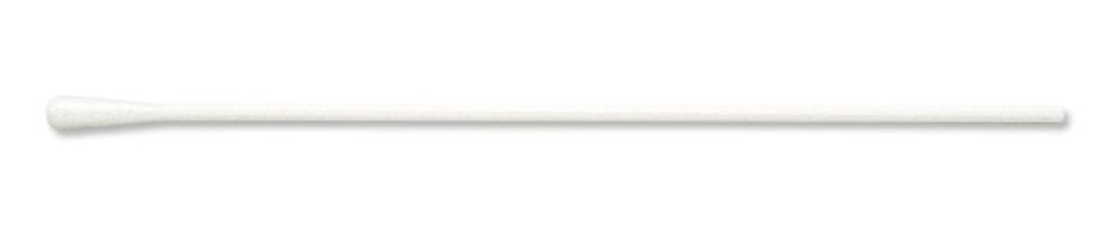
Polyester swabs (historically known as Dacron swabs) are tipped with spun polyester fiber. Polyester is favored for molecular diagnostic applications because it doesn't contain the natural inhibitors present in cotton or calcium alginate that can interfere with PCR and other nucleic acid-based tests.
Polyester medical swabs are best for: PCR-based diagnostic testing, molecular specimen collection, viral testing, applications where cotton or alginate would inhibit the assay, cleanroom-adjacent specimen collection.
Polyester medical swabs are not ideal for: Applications where cotton's higher absorbency is preferred, cost-sensitive general clinical use.
SKU highlights:
- 25-806 1PD — Sterile polyester on plastic handle, single per pack. A workhorse for diagnostic sample collection.
- 25-800 1PD ALUM — Sterile polyester mini-tip on a slender aluminum-sleeved plastic handle. Fine tip for tight anatomy or specialized diagnostic collection.
- 25-800 D 50 — Sterile polyester mini-tip on an aluminum handle.
4. Medical Foam Swabs

Foam-tipped medical swabs use polyurethane foam that is inherently lint-free; the continuous cellular structure means there are no fibers to shed. Foam is the go-to for general nasal specimen collection, wound care where lint would be a problem, and various other medical applications.
Foam medical swabs are best for: Nasal specimen collection (including flu, COVID-19, and RSV testing), wound measurement and depth assessment, applications where lint would compromise the result, precision medical device cleaning, self-collection kits.
Foam medical swabs are not ideal for: Deep nasopharyngeal collection, where flocked mini-tips perform better, applications requiring foam that resists aggressive solvents (a different foam formulation).
SKU highlights:
- 25-1506 1PF — Sterile 6" foam swab on polystyrene handle. Frequently used for nasal specimen collection.
- 25-1506 1PF DM — Wound measurement device with foam tip and depth markings.
- 1806-PF — Non-sterile foam-tipped applicator for industrial cleaning tasks.
For nasal collection specifically, see our comparison of nasopharyngeal swab vs. nasal swab methods and our wound measurement guide.
5. Medical Flocked Swabs
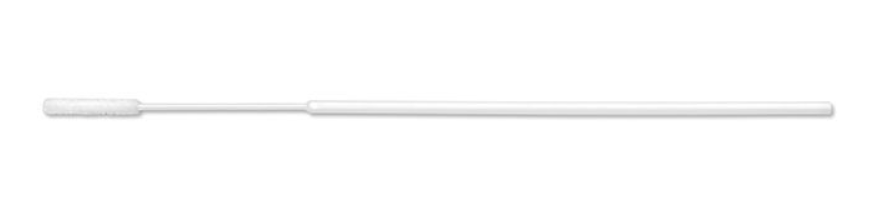
Flocked swabs are manufactured by applying short perpendicular fibers to the swab tip using an electrostatic process, creating a brush-like structure that captures cellular material more efficiently than woven or spun tips and releases it more completely during elution. Since their introduction, flocked swabs have become the standard for many molecular and diagnostic applications.
Flocked medical swabs are best for: Nasopharyngeal specimen collection, viral and molecular testing, DNA collection, forensic sample collection, applications where high specimen recovery is critical.
Flocked medical swabs are not ideal for: Applications where spun fibers’ higher absorbency is preferred, cost-sensitive general medical use.
SKU highlights:
- 25-3316-U — PurFlock Ultra® sterile mini-tip flocked swab. Used across nasopharyngeal, veterinary, and wildlife surveillance applications.
- 25-3317-H — HydraFlock® sterile ultrafine flocked swab. Nasopharyngeal and specialty collection. With Molded breakpoint at 100 mm.
- 25-3206-H — HydraFlock® sterile elongated flocked swab. Rapid diagnostic testing.
- 25-3306-U BT — PurFlock Ultra® sterile flocked swab with dry transport tube. Bacterial and DNA collection.
For a deeper look at how flocked swabs work in DNA and specimen collection, see our post on top three sterile swab types for DNA collection.
6. Medical Calcium Alginate Swabs

Calcium alginate swabs use a fiber derived from seaweed. Alginate is used in specific bacterial and viral collection protocols where the dissolvable tip is an advantage to patients to prevent infection if any fibers are left in the incision.
Calcium alginate medical swabs are best for: Nasal and throat culture protocols.
Calcium alginate medical swabs are not ideal for: PCR-based molecular testing (alginate can inhibit some PCR reactions), general clinical applications, cost-sensitive high-volume use.
Compatibility with the downstream assay is critical. Always confirm alginate compatibility with your test method's IFU before use.
Material-to-Application Reference
We put together this reference table to help you identify which material is best by application:
|
Application |
Cotton |
Rayon |
Polyester |
Foam |
Flocked |
Alginate |
|
Bacterial culture |
✓ |
✓ preferred |
✓ |
✓ |
✓ preferred |
✓ (protocol-specific) |
|
Molecular / PCR testing |
— |
— |
✓ preferred |
✓ |
✓ preferred |
Not recommended |
|
Nasopharyngeal collection |
— |
— |
✓ |
✓ |
✓ preferred |
— |
|
Wound care |
✓ preferred |
✓ |
— |
✓ |
— |
— |
|
Topical medication |
✓ preferred |
✓ |
— |
— |
— |
— |
|
DNA collection (buccal) |
✓ |
✓ |
✓ |
✓ |
✓ preferred |
— |
|
Point-of-care testing |
✓ |
✓ |
✓ preferred |
✓ |
✓ preferred |
— |

Medical Swabs by Application
Material selection is one lens for choosing a swab. Application is the other. Here's how the material types map to the specific tasks that drive selection in clinical and diagnostic settings.
1. Specimen Collection
Specimen collection is where medical swab selection matters most, because the wrong swab compromises the test that follows.
Nasopharyngeal collection is the standard for many respiratory viral tests. Flocked mini-tip swabs are the preferred choice; the flocked tip captures more material, and the flexible thin shaft reaches the nasopharynx comfortably. For more on the difference between nasal and nasopharyngeal methods, see our detailed comparison of nasopharyngeal swab vs. nasal swab methods.
Throat culture collection typically uses rayon or polyester swabs with sufficient absorbency to collect adequate cellular material. For guidance on technique, see our post on collecting a throat swab specimen.
Urogenital collection uses specialized configurations for male and female sample collection. For urethral specimen collection specifically, see our complete guide to urethral penile swabs.
Buccal (cheek) cell collection for DNA and pharmacogenomic applications typically uses flocked swabs, with results that meet the input requirements of most modern PCR and sequencing platforms. See our post on buccal swab collection for forensic analysis for procedural detail.
Nasal surveillance for MRSA uses polyester or flocked swabs collected from the anterior nares, following facility protocols. See our post on how to swab for MRSA.
2. Diagnostic Testing Workflows
Different assay types have different swab compatibility requirements.
Viral and molecular testing (COVID-19, flu, RSV, PCR panels) typically calls for flocked or polyester swabs paired with viral transport media. See our post on RSV swab testing and our comparison of RIDT vs. viral culture vs. RT-PCR.
Bacterial culture uses rayon, polyester, or cotton swabs depending on the target organism. Media compatibility matters; see our guide to Cary-Blair medium and liquid Amies transport.
STD testing typically uses polyester or flocked swabs. Our post on the ideal swab for STD testing covers material and format considerations.
3. Wound Care and Treatment
Wound assessment, cleaning, and topical application use cotton and foam swabs, chosen based on the surface, the fluid or medication involved, and whether lint is a concern. Wound measurement devices with depth markings support standardized documentation. For guidance on measurement technique, see our wound measurement guide.
Sample Transport
Getting a specimen from collection point to laboratory intact is its own workflow. Transport systems, including dry transport tubes, liquid Amies, viral transport media (VTM), and Cary-Blair medium, pair with specific swab types to preserve sample viability during transit. For an overview, see our complete guide to viral transport media.
Point-of-Care Testing
Point-of-care platforms, rapid antigen tests, molecular POC devices, and kit-based tests often specify a particular swab in the IFU. Always confirm swab compatibility with the assay before implementing at scale. For a broader perspective, see our post on how point-of-care tests can make life easier during flu season.
How to Choose a Medical Swab
Selection comes down to five questions, worked through in order.
What sample or task are you performing?
Start with the specific application: bacterial culture, PCR test, wound cleaning, topical application. The application determines everything downstream.
What sterility level do you need?
Any application involving open tissue, a sterile field, specimen collection for testing, or immunocompromised patients requires sterile packaging. General cleaning and non-critical applications can use non-sterile.
What tip material fits the assay or application?
Cotton for general use and absorbency. Rayon for bacterial culture. Polyester for molecular diagnostics. Foam for lint-free precision. Flocked for maximum specimen recovery. Alginate only for specific protocols that call for it.
What handle and length work for the anatomy or task?
3-inch swabs for tight spaces and pediatric applications. 6-inch swabs for standard adult clinical use. 8-inch swabs for deeper anatomical access. Handle material- wood, plastic, aluminum, paper affects rigidity, cost, and compatibility with the task at hand.
What transport method are you using?
Dry transport, VTM, Cary-Blair, Amies, molecular preservative; the transport method must be compatible with the swab and the downstream assay. Always confirm compatibility with your test platform's IFU.
Answering these five questions in order narrows the choice quickly. When it doesn't, consulting the manufacturer's application data, or asking a technical contact, is faster than trial and error.
How to Source Medical Swabs at Scale
For hospitals, clinical labs, diagnostic test companies, and kit developers, sourcing decisions go beyond product selection. Consistency, certifications, lead times, and traceability all matter.
Regulatory Certifications
For medical applications, look for suppliers that hold:
- FDA registration — required for medical devices distributed in the U.S. Puritan is FDA-registered.
- ISO 13485 certification — the medical device quality management system standard. Puritan is ISO 13485 certified.
- CE marking — required for medical device distribution in the European market. Puritan swabs are CE marked.
These certifications are documented on Puritan's certifications page and available on request for regulated buyers.
Traceability and Documentation
Regulated buyers need lot traceability from raw material to finished product. Certificates of Analysis (CoA), Certificates of Conformance (CoC), and material safety data sheets should be available on request. For pharmacy compounding, diagnostic manufacturing, and clinical laboratory use, these documents support internal QMS requirements and regulatory audits.
Domestic vs. Offshore Sourcing
For U.S. buyers, domestic manufacturing offers shorter lead times, easier communication on quality issues, more resilient supply chains, and reduced exposure to shipping delays and tariff changes. Puritan manufactures all products at our facilities in Maine.
Custom Configurations and Kitting
For test kit developers, diagnostic companies, and specialized applications, off-the-shelf configurations may not fit every requirement. Custom capabilities that make a difference for kit programs include:
- Custom handle length and breakpoint positions for kit fit
- Private-label packaging and labeling
- Custom sterilization to customer specifications
- Finished kit assembly with IFU inclusion
- Specific fill volumes and buffer selections for transport tubes
Custom programs typically require higher minimum order quantities than standard SKUs but can substantially reduce internal handling costs and streamline supply once established. For kit developers considering custom configurations, Puritan's customization capabilities page covers the range of options available.
Why Choose Puritan for Medical Swabs
Puritan Medical Products has manufactured single-use medical swabs and specimen collection devices at our facility in Guilford, Maine for decades. The medical swab lineup spans cotton, rayon, polyester, foam, and flocked configurations across sterile and non-sterile options, with the depth and application specificity that clinical, diagnostic, and research buyers need.
A few things worth knowing:
Application depth. The medical swab catalog includes flagship SKUs like the 806-WC and 25-806 2WC for general clinical use, PurFlock Ultra® and HydraFlock® for molecular diagnostics and specialty collection, standard and mini-tip polyester for PCR-based testing, and specialized configurations across every major clinical application.
Sterilization expertise. Both EtO and gamma irradiation are used based on which method is best suited to the product's construction and packaging. Sterilization validation follows recognized international standards.
Manufacturing consistency. Cotton fiber is USP-grade. Foam is 100 pores-per-inch polyurethane. Flocked tips are electrostatically applied to specific fiber lengths and densities. Thermal bonding — rather than adhesive — attaches tips to handles on many product lines, eliminating a common source of contamination.
Custom capability. For OEM buyers, kit developers, private-label programs, and specialized clinical applications, Puritan supports custom handle configurations, custom packaging, custom fill volumes, and finished kit assembly.
Made in the USA. All Puritan® swabs are manufactured domestically. For a look at why domestic sourcing matters for medical supplies, see why it's important to buy American when it comes to swabs.
Frequently Asked Questions
What is a medical swab?
A medical swab is a single-use applicator with an absorbent tip on a slender handle, designed for use in clinical, diagnostic, or research settings. Medical swabs are used for specimen collection, wound care, topical medication application, diagnostic testing, and sample transport. They are typically manufactured to specific quality standards and are available in both sterile and non-sterile configurations depending on the application.
What are medical swabs made of?
Medical swab tips are made from cotton, rayon, polyester (also called dacron), foam, flocked fiber, or calcium alginate. Handles are typically made from wood, polystyrene, polypropylene, aluminum, or paper. Each material has specific properties that suit different clinical and diagnostic applications.
What's the difference between a medical swab and a regular cotton swab?
Medical swabs are manufactured to specific quality standards for clinical use, are frequently sterilized and individually packaged. Regular cotton swabs (Q-tips or consumer cotton buds) are designed for general home use and are not manufactured to medical-device standards. Using a consumer swab for clinical specimen collection, wound care, or diagnostic testing can introduce contamination and compromise results.
Are all medical swabs sterile?
No. Medical swabs are available in both sterile and non-sterile configurations. Sterile swabs are required for specimen collection, wound care, sterile field applications, and use with immunocompromised patients. Non-sterile swabs are appropriate for general clinical use where the risk of introducing infection is negligible.
How are medical swabs sterilized?
Medical swabs are typically sterilized using ethylene oxide (EtO) gas or gamma irradiation. EtO is used for swabs packaged in paper or permeable pouches. Gamma irradiation is used for swabs in molded tubes and other sealed packaging. Both methods produce swabs meeting Sterility Assurance Level (SAL) of 10⁻⁶ per international standards.
What's the difference between a cotton swab and a dacron swab?
Cotton swabs use natural cotton fibers, are highly absorbent, and are widely used for general clinical applications. Dacron (polyester) swabs use synthetic fibers, generate less lint, and are preferred for molecular diagnostic testing because they don't contain the natural inhibitors that can interfere with PCR reactions.
What is a flocked swab used for?
Flocked swabs are used for applications requiring maximum specimen recovery: nasopharyngeal collection for viral testing, DNA collection for pharmacogenomics and forensics, molecular diagnostics, and specialty specimen collection. Flocked swabs capture more cellular material and release it more completely during elution than woven or fiber tip swabs.
What is the best swab for a throat culture?
Rayon and polyester swabs are commonly used for throat cultures because they collect adequate cellular material and are compatible with common bacterial culture media. Flocked swabs can also be used and may improve recovery of certain organisms. Confirm compatibility with your laboratory's specific protocol before selecting.
What is the best swab for PCR testing?
Polyester (dacron) and flocked swabs are the preferred choices for PCR testing because they don't contain the natural inhibitors present in cotton and calcium alginate that can interfere with PCR reactions. Handle material matters as well — polystyrene and polypropylene handles are typically preferred over wood.
Where can I buy medical swabs in bulk?
Medical swabs can be purchased in bulk directly from manufacturers like Puritan Medical Products or through authorized distributors such as Fisher Scientific, VWR, McKesson, and specialty medical suppliers. Direct manufacturer purchasing is typically most cost-effective at higher volumes. For custom configurations, kitting, or private-label programs, working directly with the manufacturer is essential.
Are Puritan medical swabs FDA-registered?
Yes. Puritan is FDA-registered and ISO 13485 certified for medical device quality management. Puritan medical swabs meet the regulatory requirements for medical device distribution in the U.S. and, with CE marking, in European markets as well.