Pharmacogenomic testing has moved from research application to clinical reality. A growing number of labs, testing companies, and health systems now offer panels that use genetic information to guide medication selection and dosing, particularly for psychiatric medications, cardiovascular drugs, and cancer therapies where variable drug response is well-documented.
Behind every pharmacogenomic test is a sample. And behind every sample is a collection device. Getting that device right affects DNA yield, sample stability during transport, and ultimately the confidence of the genotyping result. For labs building panels, kit developers designing collection workflows, and procurement teams evaluating options, the choice of buccal swab is not a small decision.
This guide covers what pharmacogenomic testing is, why buccal collection has become the standard, what the published literature says about swab performance, and how to think through swab selection for your workflow.
What Is Pharmacogenomic Testing?
Pharmacogenomics is the study of how a person's genetic makeup affects their response to medications. Genetic variants in drug-metabolizing enzymes, drug transporters, and drug targets can significantly alter how quickly a drug is broken down, how much reaches its target, and how effective or safe a given dose will be for a given patient.
Testing typically focuses on well-characterized variants in enzymes such as CYP2D6, CYP2C19, CYP2C9, and VKORC1, among others. Panel content varies by clinical use case:
- Psychiatric medication panels look at variants affecting metabolism of SSRIs, SNRIs, tricyclics, and atypical antipsychotics
- Cardiovascular panels assess clopidogrel, warfarin, and statin metabolism
- Oncology panels evaluate variants that affect chemotherapy response and toxicity
- Broader panels combine markers across therapeutic areas
The clinical goal is the same across use cases: reduce trial-and-error prescribing, minimize adverse drug reactions, and improve time to therapeutic effect.
Pharmacogenomic Testing vs. Genetic Testing
Pharmacogenomic testing is a subset of genetic testing focused specifically on drug response. Broader genetic testing includes ancestry analysis, carrier screening, diagnostic testing for inherited conditions, and cancer predisposition assessment. All of these share a common requirement: high-quality DNA collected without contamination and preserved until analysis.
Why Use Buccal Swabs for Pharmacogenomic Testing
Historically, DNA collection meant a blood draw. Blood remains the reference standard for yield and quality, but it requires phlebotomy, cold-chain logistics, and patient compliance with a clinical visit. Those requirements have been a real barrier to scaling pharmacogenomic testing into routine practice.
Buccal collection changed the economics. Cheek cell sampling is non-invasive, doesn't require a trained phlebotomist, and can be performed at home, at the pharmacy, or in any clinical setting. Costs drop. Compliance improves. Testing scales.
For pharmacogenomic applications specifically, buccal swabs offer three practical advantages:
1. Accessibility
Patients can collect their own samples, either at a clinic under staff supervision or at home following instructions. This is particularly relevant for pharmacogenomic testing tied to psychiatric care, where in-clinic phlebotomy adds friction to what's often an already-difficult care journey.
2. Compatibility with modern assay platforms
Buccal cell DNA is compatible with qPCR, TaqMan assays, OpenArray platforms, and most sequencing workflows used in pharmacogenomic laboratories.
3. Room-temperature stability
With appropriate transport systems, buccal samples don't require cold-chain shipping. This substantially reduces logistics costs for direct-to-consumer test companies and for centralized labs serving distributed clinical customers.
There's a real tradeoff worth acknowledging. Buccal swabs typically yield less DNA per sample than a blood draw or a saliva collection with a stabilizing solution. That gap matters more for some assays than others, and it drives real decisions about which swab type to specify for which application.
What the Literature Says About Swab Selection
A useful reference point for anyone evaluating swabs for pharmacogenomic collection is Ang et al., "Evaluation of buccal swabs for pharmacogenetics," published in BMC Research Notes in 2018. The study compared Puritan PurFlock® dry-flocked buccal swabs to sponge-tipped swabs with a stabilizing solution across 31 participants, using a pharmacogenetic panel of 28 SNPs plus a CYP2D6 copy number variation assay.
The study found meaningful differences worth understanding:
- Sponge-tipped swabs with stabilizing solution produced significantly higher DNA yield than dry-flocked swabs (p = 4.4 × 10⁻⁷)
- Genotyping call rates were higher with sponge-tipped stabilized samples (97%) versus dry-flocked (54%)
- CNV confidence scores were higher for stabilized samples (0.99 vs. 0.88)
The finding is not a knock on flocked swab technology. It's a signal about the value of a stabilizing solution in the collection workflow, especially for sensitive downstream assays that require high DNA concentration and quality. A dry flocked swab handled well and shipped promptly produces usable DNA for many pharmacogenomic panels. A dry flocked swab that sits in transport for a week, or an assay that pushes the limits of input DNA, is a different story.
For labs and kit developers, the practical takeaway is that swab selection should be evaluated in the context of your specific workflow: your target assays, your sample volume requirements, your shipping conditions, and your acceptable failure rate. There isn't a single right answer.
Puritan's DNA Collection Product Lines
Puritan's DNA and genetics collection portfolio is organized around the workflow considerations that shape swab selection:
DNA-free Flocked Swabs
Manufactured under conditions that minimize the risk of exogenous DNA contamination. Critical for applications where trace contamination could affect results, particularly at low-input DNA thresholds. Available in HydraFlock® and PurFlock Ultra® configurations with polystyrene handles and standard 6-inch overall length.
DNA Controlled Line
Includes the FAB-SWAB® dry transport system, which pairs a flocked swab with a perforated-cap transport tube. The perforated cap allows for airflow during transport, which supports drying of the sample and reduces the risk of microbial growth during shipping.
Cap-Shure® Swabs
Feature aerated protective caps designed to allow drying while the swab is contained. Useful for direct-to-consumer test kits and for clinical workflows where the swab needs to be collected, capped, and shipped without a separate drying step.
Molecular Preservative Solutions
For workflows where sample stability during transport is critical, Puritan offers molecular preservative products that stabilize nucleic acids at ambient temperature. This addresses the stability-related concerns raised in the Ang et al. study for labs that need to protect DNA yield across variable transport conditions.
For a broader overview of Puritan's DNA collection options, see our related post on the top three sterile swab types for DNA collection.
Learn more about Puritan’s PurFlock Ultra 6” Standard Flock Swab with Polystyrene Handle and 80mm Breakpoint - a popular choice for pharmacogenomic testing.

How to Evaluate a Buccal Swab for Your Pharmacogenomic Workflow
Four practical questions to work through when specifying a swab for pharmacogenomic collection:
1. What is your target DNA input?
Modern qPCR-based pharmacogenomic panels can work with relatively low input, while some sequencing-based workflows require more starting material. Match the swab and transport system to the input requirement of your most demanding assay, not your average case.
2. Where is the sample being collected?
In-clinic collection with immediate processing has different requirements than at-home collection with 3-to-7-day mail-back transit. The latter case argues for aerated transport, molecular preservative, or both.
3. How sensitive are your downstream assays to exogenous DNA?
Sensitive PCR and sequencing workflows benefit from DNA-free-manufactured swabs. Less-sensitive genotyping assays may not need that additional control.
4. What are your kit design constraints?
Handle length, breakpoint position, tube geometry, and packaging all affect kit assembly, patient usability, and shipping cost. Off-the-shelf configurations work for many use cases; custom configurations become worthwhile at meaningful volume.
If your workflow includes collection at a pharmacy or point-of-care setting, patient usability and single-handed operation may weigh heavier than in-lab collection scenarios where a trained collector handles the swab.
Swab Test vs Spit Test for Pharmacogenomics
The choice between a swab and a spit test for pharmacogenomics largely depends on the specific requirements of the test being conducted, the setting, and the subject's ability to provide a sample. Swab tests offer a controlled, quick, and less variable method of collection, making them ideal for clinical environments and situations requiring high precision. On the other hand, spit tests offer a convenient and user-friendly option, suitable for at-home testing kits and scenarios where sample collection's ease and comfort are prioritized.
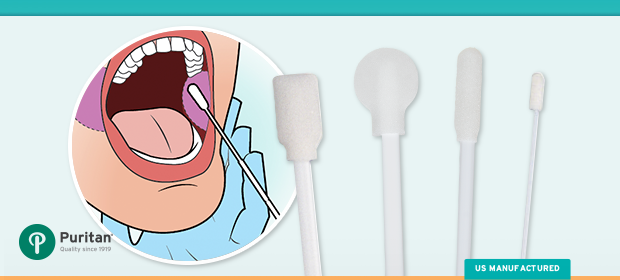
For pharmacogenomics, Puritan supports swab testing with our products. The swab test, particularly the buccal swab, involves gently rubbing a specialized swab against the inside of the cheek to collect cells. This method is highly favored for its non-invasive nature, ease of use, and the reliable quality of DNA it can collect. Swab tests are particularly useful in clinical settings or when conducting tests on a broad scale due to their straightforward, quick, and relatively error-proof collection process.
Moreover, swab tests minimize the risk of sample dilution or contamination, providing a robust source of DNA for pharmacogenomic analysis. They are especially suitable for individuals who may have difficulty producing sufficient saliva for a spit test or for populations such as infants and the elderly.
How to Collect a Buccal Sample
For readers who need a procedural reference, buccal collection is straightforward but benefits from consistency across collectors. A standardized approach improves comparability of results across a patient population.
The general procedure:
- Handle the swab by its stick only, avoiding contact with the swab tip. If the swab has a breakpoint indicator, hold above that mark.
- Ask the patient to open their mouth. Insert the swab and firmly rub the tip against the inside of one cheek approximately 10 times, using enough pressure to collect epithelial cells but not so much as to cause discomfort or bleeding.
- Rotate the swab 90 degrees and repeat on the same cheek. Then repeat the process on the opposite cheek to maximize cell yield.
- Remove the swab without touching teeth, tongue, gums, or other surfaces that could contaminate the sample.
- Follow the specific handling instructions for your transport system. Dry-transport workflows require air-drying before capping. Preservative-based workflows immerse the swab immediately.
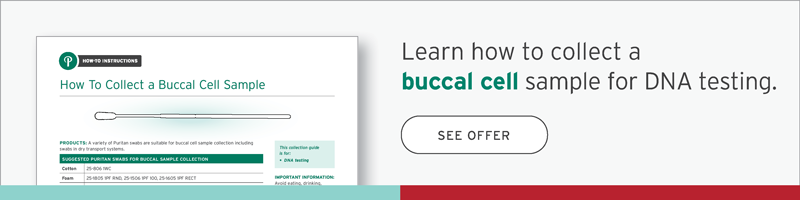
For a printable version of this workflow, see Puritan's buccal cell collection guide.
Always confirm swab and transport medium compatibility with your test platform's IFU before implementing at scale.
Custom Pharmacogenomics Kitting and OEM Configurations
Standard product configurations serve many pharmacogenomic testing applications well. For companies building branded test kits, direct-to-consumer offerings, or clinical panels at scale, off-the-shelf may not meet every requirement.
Puritan supports custom configurations across the DNA collection portfolio, including custom handle lengths and breakpoint positions, private-label packaging, kit assembly with instructions for use, custom fill volumes for preservative-based systems, and sterilization to customer specifications. For test companies and labs scaling collection programs, folding kitting into the supply arrangement can reduce internal handling costs and shorten time to fulfillment.
If you're evaluating a custom collection solution for a pharmacogenomic panel or kit, our product team can walk through your specific requirements.
Why Work With Puritan For Your Genetic Testing Kit
Puritan has manufactured single-use swabs and specimen collection devices at our facility in Guilford, Maine since 1919. The DNA and genetics product portfolio is built around the specific requirements of nucleic acid collection: minimizing exogenous DNA contamination through controlled manufacturing, engineering flocked fiber structures for improved cell capture and elution, and offering transport systems that address the stability challenges of ambient-temperature shipping.
For labs and test kit companies, working with a U.S.-based manufacturer that can support standard configurations, custom kitting, and regulatory documentation from a single facility simplifies both supply chain and quality management. Puritan is registered with the FDA, ISO 13485 certified, and CE registered.
Why Choose Flocked Material for Pharmacogenomic Swab Tests
In the evolving field of pharmacogenomics, the quality of the DNA sample collected is paramount. This is where Puritan’s flocked swabs stand out as the optimal choice for pharmacogenomic testing.
- Optimized Sample Collection and Release: Puritan's commitment to excellence is embodied in its HydraFlock® and PurFlock Ultra® flocked swabs, designed with user feedback and proprietary manufacturing processes. These swabs feature an intricate fiber technology, patented for its remarkable collection and elution capacities—among the highest available in the market. This makes them particularly suitable for sensitive pharmacogenomic applications where maximizing the quantity and quality of the collected genetic material is crucial.
- Material Integrity for Accurate Testing: The tips of these swabs are made from flocked polyester fibers, meticulously engineered to absorb organisms efficiently at the collection site and maintain viability during transport and elution. The unique structure of the fibers, with HydraFlock® having blossomed ends to increase the surface area, ensures higher absorption capacity and complete elution of the sample. This characteristic is vital for pharmacogenomic testing, where every genetic marker counts towards tailoring personalized medication regimens.
- Purity and Compatibility: PurFlock Ultra® is celebrated for its ultimate purity and efficient cell release characteristics, making it an ideal choice for PCR, molecular assays, rapid tests, and forensic applications. Unlike other materials that may have coatings or treatments that interfere with sample integrity, Puritan’s flocked swabs ensure that what is collected is a pure representation of the patient's DNA, free from external contaminants.
- Designed for Convenience and Efficiency: Moreover, Puritan's attention to the practical aspects of sample collection is evident in the design of their swabs. With handles featuring varying, pre-molded breakpoints and the option for custom breakpoints and print, healthcare professionals can easily use and transport the swabs, simplifying the collection process. The absence of adhesive residue or fiber treatments further underscores the commitment to sample integrity and ease of use.
Frequently Asked Questions
What Is the Purpose of Pharmacogenomics Testing?
Exploring the practical applications of pharmacogenomics testing reveals its pivotal role in modern medicine. Here's a closer look at the key areas where this innovative testing makes a significant impact:
- Personalizing Drug Therapy: Tailoring medication types and dosages to the individual's genetic makeup to maximize efficacy and minimize adverse effects. This customization ensures that patients receive the most appropriate medication for their unique genetic makeup.
- Improving Drug Safety: By understanding how different genetic variations affect drug metabolism, pharmacogenomics testing can significantly reduce the risk of adverse drug reactions, a leading cause of hospitalizations and patient morbidity.
- Enhancing Drug Development: Pharmacogenomics can identify which drug compounds are likely to be most effective for specific genetic profiles, streamlining the drug development process and leading to more targeted and successful therapies.
- Guiding Dosage Amounts: Certain genetic markers can influence how quickly or slowly a person metabolizes a drug, affecting the drug's concentration in the body. Pharmacogenomics testing helps determine the optimal dosage for each patient, avoiding underdosing or overdosing.
- Predicting Drug Efficacy: Before starting a treatment regimen, pharmacogenomics can predict whether a patient is likely to respond to a given medication, allowing healthcare providers to make informed decisions and potentially avoiding trial and error with different drugs.
- Cost Effectiveness: Tailoring medicine prescriptions saves time spent on trying different drugs, as well as health insurance and tax payer’s money.
- Advancing Precision Medicine: As a cornerstone of precision medicine, pharmacogenomics testing paves the way for more personalized, predictive, and preventive healthcare, shifting the paradigm from a one-size-fits-all approach to more individualized care.
What is a buccal swab and how is it used in pharmacogenomic testing?
A buccal swab is a sterile applicator with a soft, absorbent tip used to collect cheek cells for DNA analysis. In pharmacogenomic testing, the swab is rubbed against the inside of the cheek to collect epithelial cells, which are then processed in a laboratory to genotype variants that affect drug metabolism and response.
Are buccal swabs as accurate as blood samples for pharmacogenomic testing?
Blood remains the reference standard for DNA yield and quality, but buccal swabs collect enough DNA for most modern pharmacogenomic assays when appropriate collection technique, storage, and transport are used. Assay sensitivity, sample stability during transport, and collection technique all affect real-world accuracy.
What's the difference between a flocked swab and a spun-fiber swab for DNA collection?
Flocked swabs use short fibers bonded perpendicular to the swab tip to create a brush-like structure. This design collects more cellular material and releases it more completely during elution than spun-fiber or wound-tip swabs, which trap material within the fiber matrix. For DNA collection, flocked construction typically produces higher yield and cleaner elution.
Do buccal swab samples need to be refrigerated for pharmacogenomic testing?
It depends on the transport system. Dry transport with proper air-drying supports room-temperature shipping for most pharmacogenomic applications. Preservative-based transport systems stabilize DNA at ambient temperature for extended shipping windows. Always confirm requirements with your test platform's IFU.
Can pharmacogenomic testing be performed with at-home sample collection?
Yes. Many pharmacogenomic testing companies use at-home collection kits with buccal swabs, driven by patient convenience and cost efficiency. Kit design considerations include easy-to-follow instructions, tamper-evident packaging, aerated transport for sample stability, and prepaid return shipping.
What is the CYP2D6 gene and why is it important in pharmacogenomic testing?
CYP2D6 encodes an enzyme responsible for metabolizing many commonly prescribed medications, including several antidepressants, antipsychotics, opioids, and cardiovascular drugs. Genetic variation in CYP2D6, including copy number variation, significantly affects drug metabolism rates. It is one of the most frequently tested markers in pharmacogenomic panels.
Can I use pharmacogenomic testing swabs for other genetic testing applications?
Buccal swabs used for pharmacogenomic collection are generally suitable for other genetic testing applications including ancestry, carrier screening, and forensic identification. However, specific applications may have unique requirements (e.g., DNA-free-manufactured swabs for low-input forensic work). Confirm swab specifications against your application's requirements.
Citation:
Ang JS et al., "Evaluation of buccal swabs for pharmacogenetics," BMC Research Notes 2018. Link: https://bmcresnotes.biomedcentral.com/articles/10.1186/s13104-018-3476-5