If you have a cleanroom, you understand the importance of meeting stringent requirements. So does Puritan Medical Products. We manufacture our PurSwab line of critical environment (CE) swabs in our ISO 13485:2016-certified and CE-compliant facility to provide the reliable, consistent performance you expect from the end products that you purchase. The question is, what type of swab is best for your specific needs?
As you read through the overview of swab shafts and tips below, you’ll see our PurSwab brand line of swabs offers plenty of choices for cleanroom applications. With these details on our tipped applicators, you can confidently select the cleanroom swabs that best meet your needs.
What are cleanroom swabs?
A cleanroom’s controlled environment must minimize the pollutants such as dust and other airborne particles. However, even the cleanest environments feature materials, systems, and people that can potentially generate microscopic particles despite the best protections. Lessening this emission through careful choice of materials – including cleanroom swabs – is important.
Whether you’re manufacturing sensitive electronics, medical equipment, pharmaceuticals, or other delicate components, you have to be able to trust that your cleaning solutions meet your minimum for allowable particles per cubic meter. Cleanroom swabs are specially formulated to reduce the potential for lint and other residue, among other specialized features.
Understanding the types of cleanroom swabs
Just as there are many types of cleanroom applications, there are cleanroom swabs specially formulated to meet unique needs. These simple tools have two critical components to consider:
- Shaft material: You have several options to choose from when it comes to swab handles, including wood, polypropylene, and paper. This variation allows users to select a material with the appropriate amount of stiffness or give for the task at hand.
- Swab tip: There are far more options available when it comes to the tip of your cleanroom swabs. These range from cotton and compressed cotton to foam, foam over cotton combinations, knitted polyester and microfiber. The option you select will depend upon your need for absorption of cleaning agents or liquid contaminants, allowable abrasiveness and potential for linting, and other features. Some cleanroom swabs’ tips are formulated to offer additional benefits, including chemical resistance or antistatic and electrostatic discharge (ESD) properties.

Choosing the right cleanroom swab handle
Below is a deeper dive into the benefits and applications of each cleanroom swab handle material to help you match the appropriate tool to your application:
Polypropylene shafts
 Molded or extruded options are available
- Can be glass-filled for extra rigidity
- Can be blended with carbon for conductivity
- Can be blended with inherently static-dissipative polymers
Paper shafts
- Compressed

- Stiff
- Biodegradable
- Most often used with compressed cotton/lint-free tips
- Used in manufacturing disk drives
- The paper is stiff, clean, and makes for a “green” tip-to-toe construction
Wood shafts
- Northern white birch
- A “natural” material
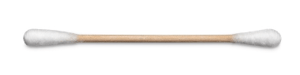
- Rigid
- Contains particulates, so not typically recommended for cleanrooms
Choosing the right cleanroom swab tip material
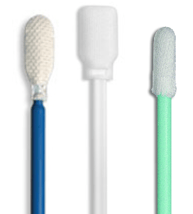
Below, we’ve outlined the benefits and uses of each cleanroom swab tip material to help you match the right properties to your application. However, it is also important to note that many of these swab tips come in varying shapes – including pointed, rectangular, and corkscrew – to aid users in specific cleaning or application tasks.
Knitted Polyester
- Soft, non-abrasive, and lint-free
- Can easily withstand IPA, acetone, and other solvents
- Non-absorbent
- Low particle generation and low non-volatile residues (NVRs)
- Made in a Class 1000 cleanroom
- Ideal for cleaning electronic and communication devices and perfect for instrumentation and medical device manufacturing
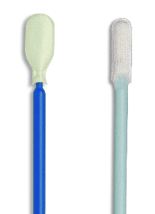
Microfiber
- Soft and non-abrasive
- Low particle generation and low NVRs
- Absorbent
- Resistant to normal cleaning solvents, which makes them ideal for removing contaminants and excess materials in fine assembly environments
- The fiber is made from denier thread smaller than polyester
- Suitable for cleanrooms, fiber-optics, and component manufacturing
PurSwab foam
- Synthetic – polyurethane foam
- 100 PPI provides good particle entrapment
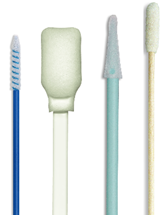
- Options include open-cell, closed-cell, dissipative, highly absorbent, and chemical-resistant styles
- Non-linting, making it good for removing epoxy residue from connectors, in general cleaning, or as a flux remover
- Thermal edge seals and thermal bonding to the handle helps ensure the sponge-like foam will clean up unwanted particles without releasing any into your environment
Foam Over Cotton
- Made from shred-resistant urethane foam over USP
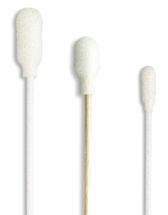 pharmaceutical-grade cotton for the best absorption that performs well when cleaning with solvents
 - Friction bond
- Foam over cotton holds up better under vigorous use than stand-alone cotton
- Extra absorption
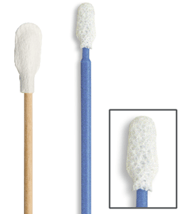
Chemical-resistant foam
- Made of a unique polymer that stands up to most solvents and aggressive chemicals (including acetone)
- Used for general cleaning, removing and applying adhesives and other solutions
- The slight texture of the foam creates a light abrasion
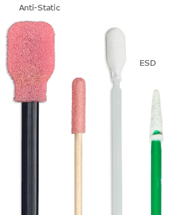 Antistatic and ESD materials
- To prevent electrostatic discharge (ESD) and static buildup electronics and other sensitive devices should only be cleaned with ESD and/or anti-static swabs
- Designed for working in and around static-sensitive components and parts
- Anti-static applicators are made with an anti-static foam tip and a conductive polypropylene handle or standard wood handle
- ESD applicators are made with anti-static handles and have unique tips, some are made of ESD conductive foam, polyester, cotton, and non-woven materials
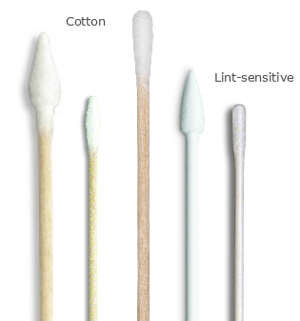
Cotton tips
- “Standard”
- Absorbent, linty
- Soft
- Many configurations possible
- Inexpensive, readily available
- Useful for non-medical applications
Cotton tips for lint-sensitive applications
- Non-linting and residue-free
- Soft
- Some offered in anti-static packaging
- Typically double-tipped
- Used in HDD manufacturing
- Suitable for cleanrooms
- Smallest tips starting at 2 mm
- Bulb and pointed styles
Which combination is right for your application?
Below you’ll find a snapshot of the types of materials that work well with a few common cleanroom applications.
| Application | Suitable swab |
| General cleaning | |
| Precision cleaning and contamination removal | |
| Fiber optic cleaning | |
| Applying adhesives and other solutions | |
| Precision manufacturing | |
| Electronics manufacturing | |
| Medical device manufacturing |
Does your specialty application call for a swab that you don’t find here? Reach out to discuss possible customization solutions.
What to look for in a cleanroom swab supplier
If you’re exacting in your cleanroom equipment, then it’s important to also be exacting in your cleanroom equipment supplier. Puritan Medical Products is committed to delivering a superior product for every application. This begins with selecting the highest quality materials and continues through our stringent manufacturing specifications to ensure we provide the quality to meet your demands.
Our sales representatives are happy to help you determine which swab shaft and tip combinations are best for your specific needs. Whether you have questions about what you need or are ready for the next steps, we look forward to speaking with you. Contact us today.
Cleanroom swabs FAQs
What is a cleanroom swab, and how is it different from a standard swab?
Cleanroom swabs are designed to minimize particle generation, lint, and residue in controlled environments. Compared to standard swabs, they are manufactured and constructed to better support contamination control requirements. The goal is to clean or apply materials without introducing new contaminants.
How do I choose the right swab tip material?
Start with your task: absorption, abrasion level, and lint tolerance. Foam and microfiber are often used for low linting and contamination control, while cotton offers higher absorption but may introduce lint. Match the tip to your cleaning agents and the sensitivity of the surface.
What factors matter when selecting a swab handle (shaft)?
Handle material affects rigidity, flexibility, and compatibility with your environment. Polypropylene offers versatility and can be engineered for conductivity or static control, while paper is stiff and often used in specific manufacturing workflows. Wood is rigid but may introduce particulates, so it is not typically recommended for cleanrooms.
When should I use antistatic or ESD-safe swabs?
Use antistatic or ESD-safe swabs when working around static-sensitive components such as electronics. These swabs are designed to help prevent electrostatic discharge and reduce the risk of damage during cleaning. Confirm requirements with your facility’s protocols for handling sensitive components.
Which swab materials are best for low lint and low residue?
Knitted polyester, microfiber, and foam tips are commonly selected for low particle generation and low non-volatile residues. These materials are suited for precision cleaning where contamination control is critical. The exact choice depends on your solvent use and surface sensitivity.
How do I choose a swab for solvent use, like IPA or acetone?
Select a tip material that is compatible with your cleaning solvent and won’t degrade or shed. Knitted polyester and certain foam options are designed to withstand common solvents. This can vary by workflow, so confirm with your protocol or lab requirements.
What’s the difference between foam, microfiber, and polyester tips?
Foam tips are non-linting and effective for particle removal and general cleaning. Microfiber offers higher absorbency with low particle generation, making it useful for fine assembly work. Knitted polyester is non-absorbent and low-residue, often used where solvent resistance and precision are priorities.
Are cotton swabs suitable for cleanroom use?
Standard cotton swabs are absorbent and cost-effective but can generate lint, which may not be suitable for sensitive environments. Some cotton configurations are designed to reduce lint and are used in specific cleanroom applications. Always match the swab to your contamination tolerance.
How does swab shape impact performance?
Tip shape affects access and application control. Pointed, rectangular, or corkscrew designs help reach tight spaces or apply materials more precisely. Choose a shape based on the geometry of the surface or component you’re working with.
What are common mistakes when selecting cleanroom swabs?
Using a swab that sheds lint, is incompatible with your solvent, or lacks the right rigidity can impact results. Over-handling or using the wrong tip shape can also introduce contamination or reduce effectiveness. Align your selection with the task and environment requirements.
Should I standardize swabs across teams or applications?
Standardization can simplify purchasing and training, but different applications often require different materials and properties. Many facilities use a core set of approved swabs for common tasks and allow exceptions for specialized workflows. This can vary by workflow, so confirm with your protocol or lab requirements.